readings/w6):

Indeed, partly because F0 contours are so simple, it is possible, as pointed out by Kochanski & Shih (2003), to model them in great detail without providing any insight into their linguistic aspects. (Arvaniti and Ladd 2009, p. 46)
We define a set of tags that serve the dual function of marking the text and pitch generation. The user can use these tags to describe linguistic events, and the tags automatically provide pitch generation support. It is thus most important to allow the model we define to represent any possible prosody.\(^1\)
\(^1\) We use the term ‘‘prosody’’ broadly, meaning a time series of speech information that's not predictable from a reasonable window (e.g., word sized or sentence sized) applied to the phoneme sequence. This could include pitch, amplitude, and gestures. The tag set also applies to tone shapes in tone languages, so we bring them under the umbrella term ‘‘prosody.’
From a research point of view, it is important to have a model that bridges the gap from linguistic theories to the objective reality of a glottal oscillator with a time-varying frequency. The model needs to be general enough so that it can provide a quantitative representation of many different theories of intonation, and can therefore be used to compare theories.
readings/w6)A full discussion of the issue of linguistic representation is given in Sec. IV, but we will now give the main desired properties of such a representation:
(1) Constrained. The representation should be as compact as possible having few degrees of freedom. Specifically, redundancy should be absent so that one part of the representation cannot be derived from another.
(2) Wide coverage. The representation should cover as many intonational phenomena as possible and should be capable of expressing distinctions in utterances which are perceptually different.
(3) Linguistically meaningful. The form of the representation should be such that its parameters can be interpreted and generated by higher-level components.
It is clear that these properties have a tradeoff: an unconstrained system with many degrees of freedom will have wider coverage than a system with few. The notion of providing constrained, compact models is common throughout linguistics and it is a general rule of thumb that a compact representation system with low redundancy and an orthogonal description space is a better linguistic representation than one without these properties. Furthermore the properties of the linguistic representation interact with the two further goals:
Automatic synthesis. The model should have an automatic mechanism for generating F0 contours from the linguistic representation.
Automatic analysis. It should be possible to derive the linguistic representation automatically from an utterance’s acoustics.
It is fairly easy to design a representation which is a amenable to automatic analysis and synthesis if one is not worried about the linguistic relevance of the representation.
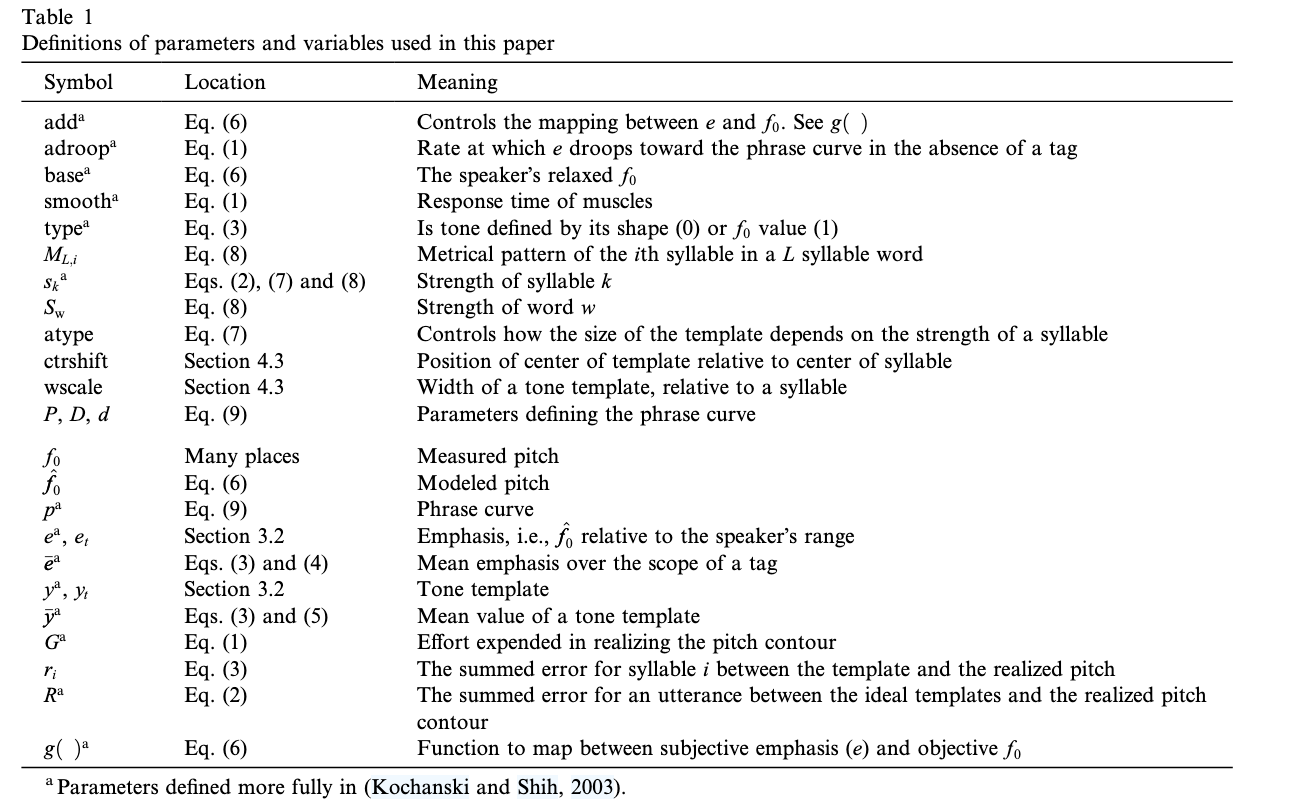
Table 1 from Kochanksi and Shih (2003) (in readings/w6):
readings/w6/)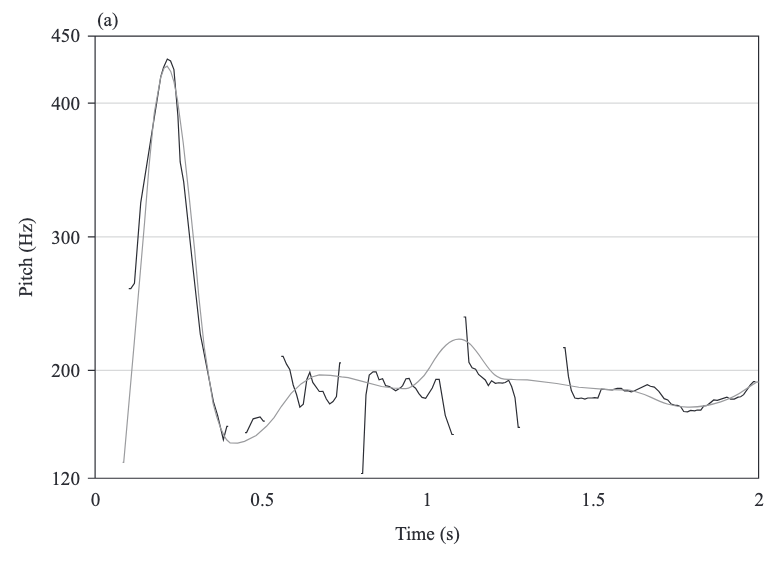
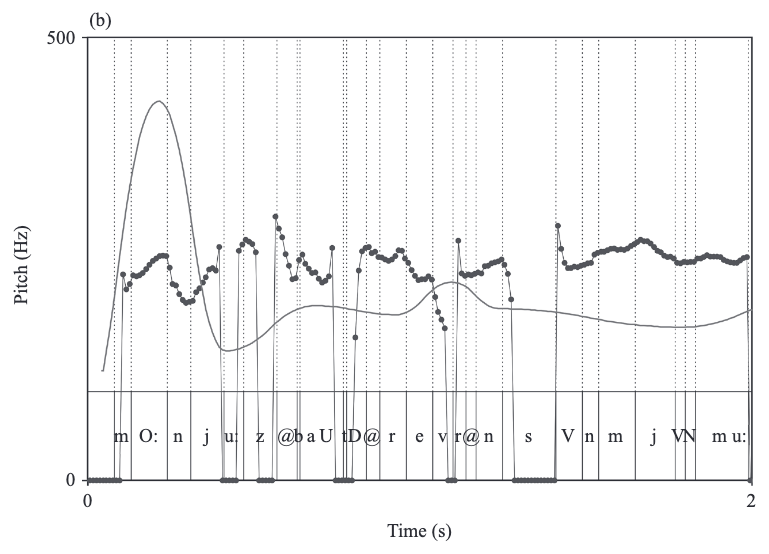
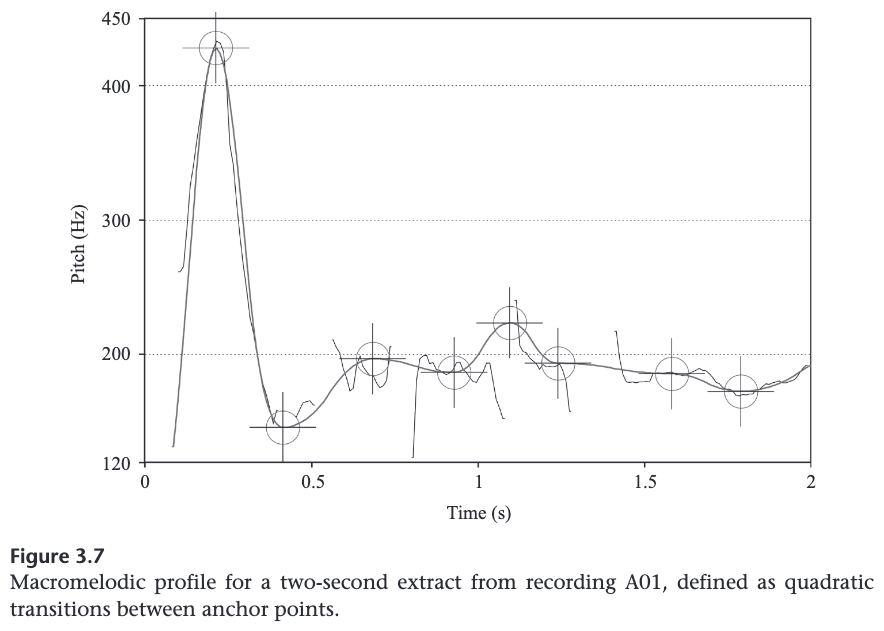
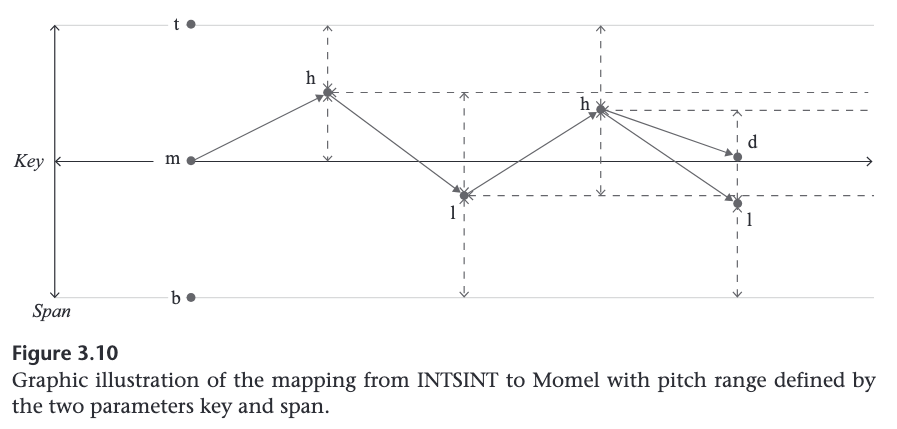
The Momel representation is formally equivalent to a subset of the contours that can be produced by the rise/fall/connection (RFC) model of intonation later developed by Paul Taylor (1994) as a tool for speech synthesis. The only difference is that the RFC model allows linear interpolations between two successive anchor points, as well as quadratic interpolations. If two successive anchor points have the same value of F0, then the transition will be linear (i.e., flat) with Momel too. I have personally never observed a case where a nonflat linear transition gives a better approximation to an F0 curve than a quadratic one.
readings/w6/), see Fig 1 below: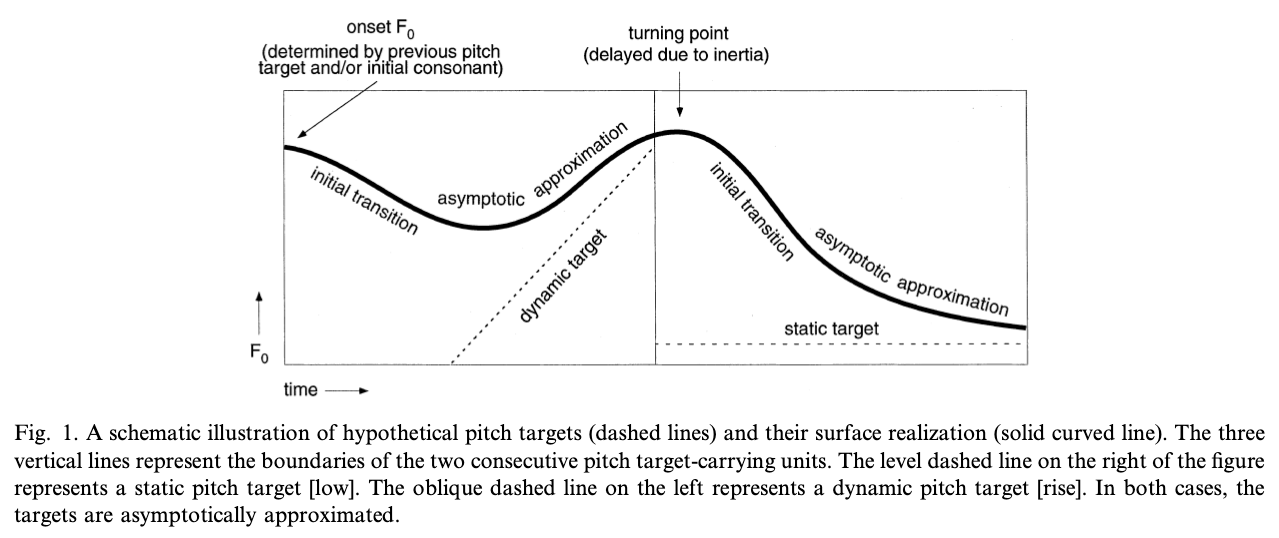
readings/w6/)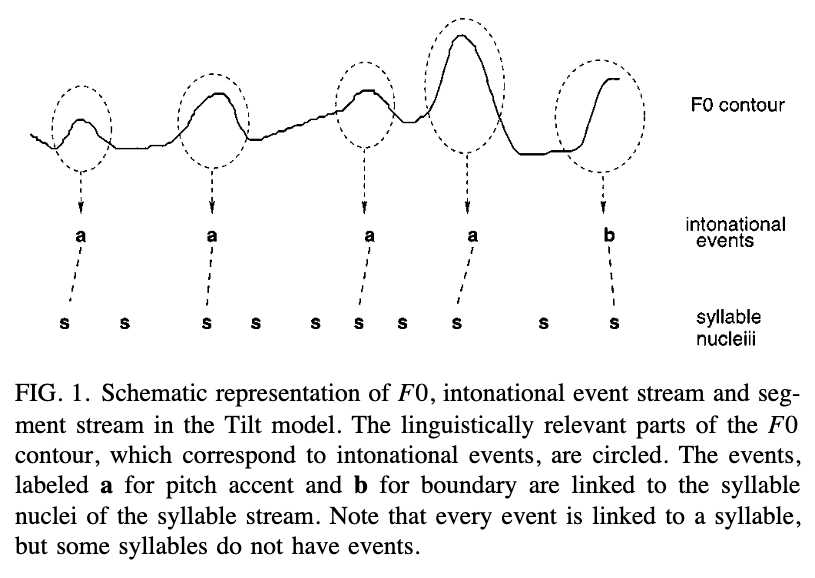
readings/w6)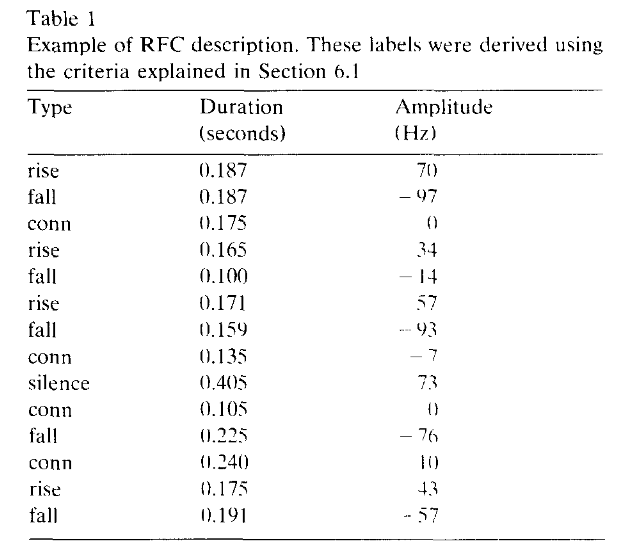
Tilt parameters (updated from Rise-Fall-Connection model):
\[ \text{tilt} = \frac{ \vert A_{rise}\vert - \vert A_{fall}\vert}{2\left(\vert A_{rise}\vert + \vert A_{fall}\vert\right)} + \frac{ \vert D_{rise}\vert - \vert D_{fall}\vert}{2\left(\vert D_{rise}\vert + \vert D_{fall}\vert\right)} \]
readings/w6)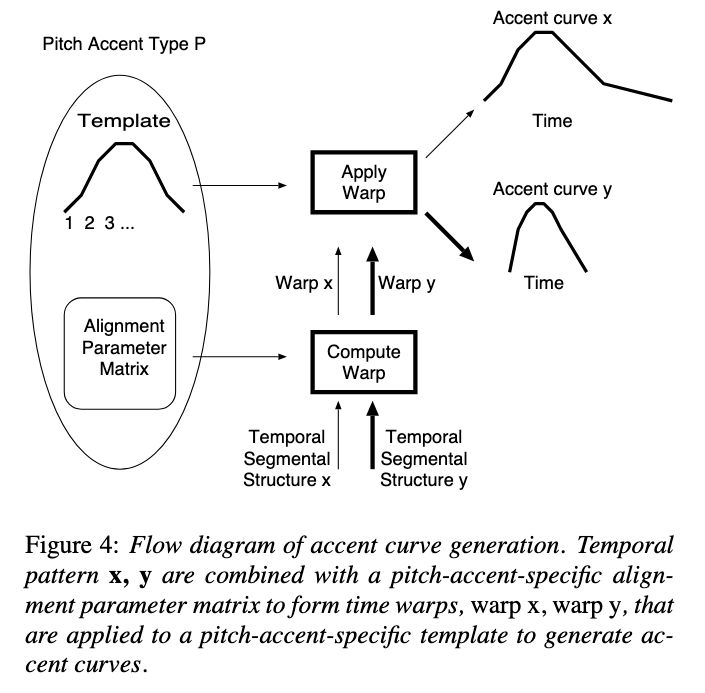
readings/w6/)Intonation production is generally considered a two-step process: an accent or tone class is predicted from available information, and then the tone class is used to generate f0 as a function of time. Historically, most attention has been paid to the first, high level, step of the process. We here show that by focusing on f0 generation, one can build a model that starts with acoustic data and reaches far enough up to connect directly to linguistic factors such as part-of-speech, word length and position in the text.”
Specifically, we present a model of Mandarin Chinese intonation that makes quantitative f0 predictions in terms of the lexical tones and the prosodic strength of each word. The model is able to generate tonal variations from a few tone templates that correspond to lexical tones, and accurately reproduce f0 in continuous Mandarin speech with a 13 Hz RMS error. The result is comparable to machine learning systems that may use more than one hundred tone templates to account for Mandarin tonal variations. (Kochanski, Shih, and Jing 2003, p. 625)
Described another way, a Stem-ML model is a function that produces a curve of f0 vs. time. The resulting curve depends on a set of adjustable (free) parameters which describe things like the shape of tones, how tones interact, and the prosodic strength of each syllable. When Stem-ML is generating a f0 curve, one can set these parameters to any values, and each setting will get you a different curve. In reverse, one can find the best values for the parameters via data fitting procedures. (Kochanski, Shih and Jing 2003, p. 626)
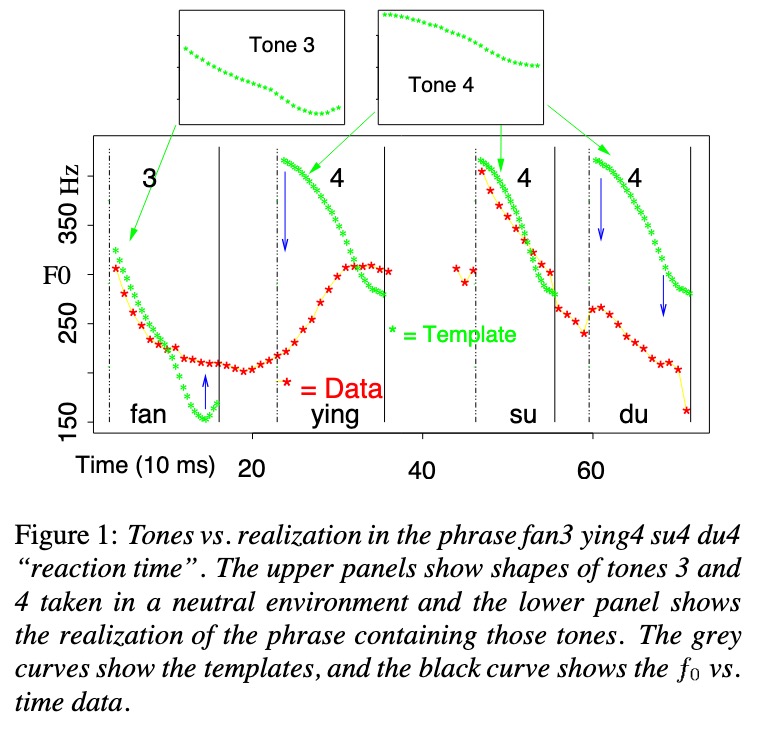
Comparison to past work: up to hundreds of discrete classes to represent tonal variations
Motivating example, from Shih et al. (2001).