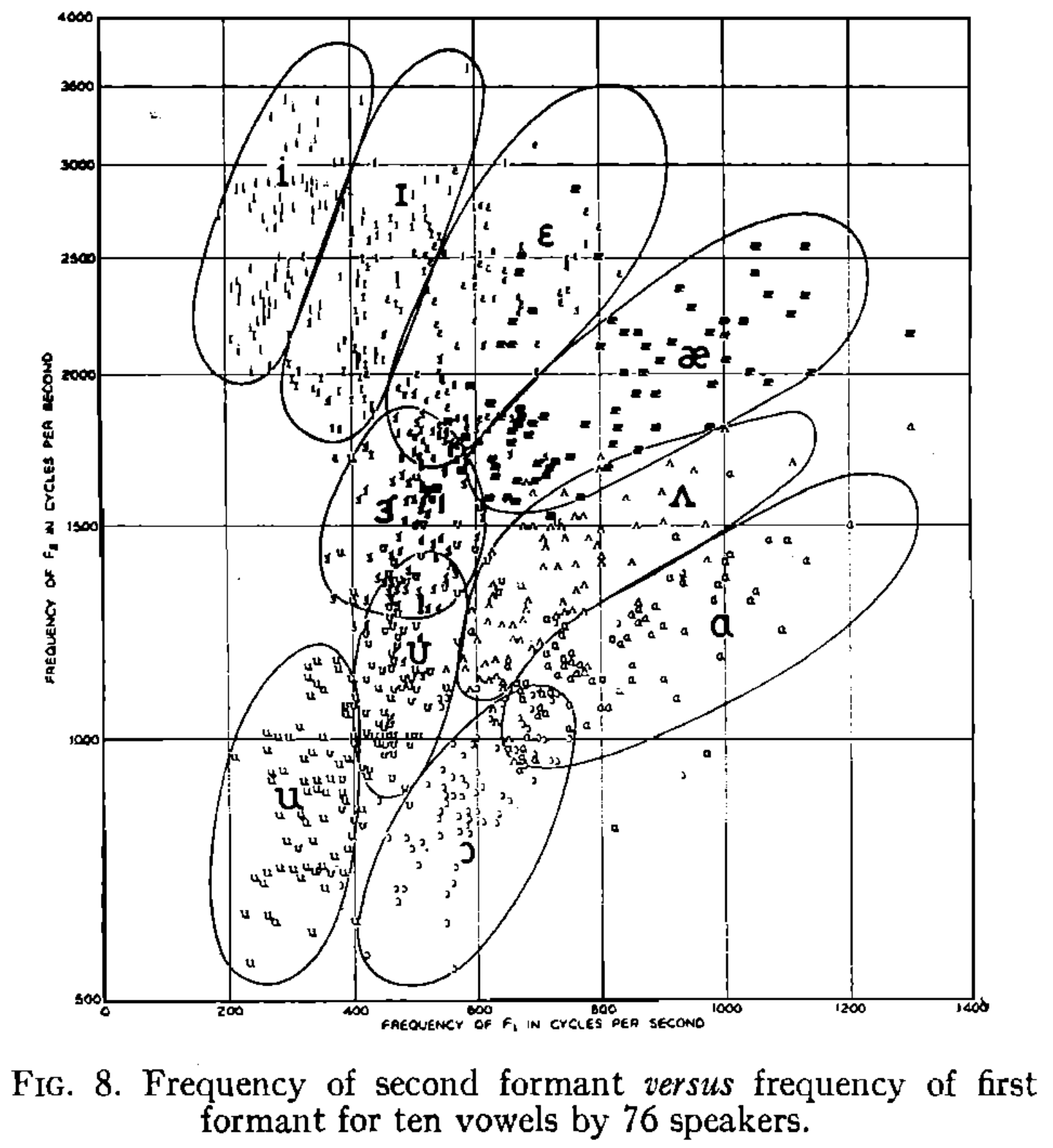
What is a tone? What is a vowel?
Peterson and Barney (1952, p. 182)
3Blue1Brown on vectors:
In truth, it doesn’t matter whether you think of vectors as fundamentally being arrows in space that happen to have a nice numerical representation, or fundamentally as lists of numbers that happen to have a nice geometric interpretation. The usefulness of linear algebra has less to do with either one of these views than it does with the ability to translate back and forth between them. It gives the data-analyst a nice way to conceptualize many lists of numbers in a visual way, which can seriously clarify patterns in the data and give a global view of what certain operations do. On the flip side, it gives people like physicists and computer graphics programmers a language to describe space, and the manipulation of space, using numbers that can be crunched and run through a computer.
Let's take this still of geometric and numerical perspectives for vectors from 3Blue1Brown's lesson on vector spaces. What does this remind you of, from thinking about phonetic spaces?
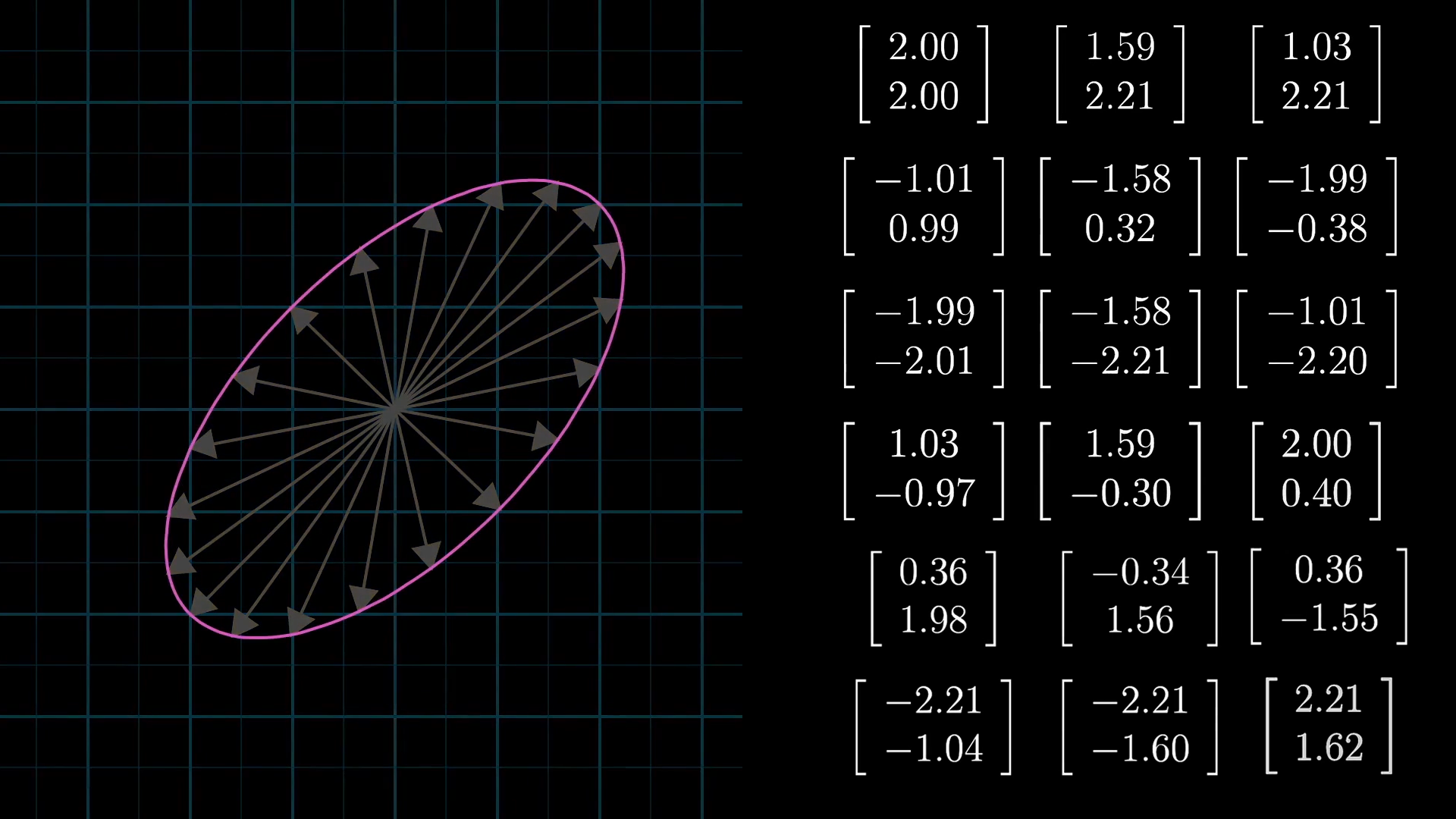
What's that "graph paper" representing? It's \(\mathbb{R}^2\)! Slightly more formally, from Axler (2024, Example 1.7):
The set \(\mathbb{R}^2\), which you can think of as a plane, is the set of all ordered pairs of real numbers: \[ \mathbb{R}^2 = \{(x,y) : x, y \in \mathbb{R}\} \]
(What's the definition of \(\mathbb{R}\)? \(\mathbb{R}^3\)?)
How do we generalize to higher dimensions? From Axler (2024, Definition 1.8):
(a) Suppose \(n\) is a nonnegative integer. A list of length \(n\) is an ordered collection of \(n\) elements (which might be numbers, other lists, or more abstract objects)
(b) Two lists are equal if and only if they have the same length and the same elements in the same order.
...A list of length \(n\) might look like this:
\( (x_1,\ldots,x_n) \)
So to generalize to \(\mathbb{R}^n\), see Axler (2024, Definition 1.11) (that definition generalizes also to complex spaces)
\(\mathbb{R}^n\) is the set of all lists of length \(n\) of elements of \(\mathbb{R}\):
\[ \mathbb{R}^n = \{(x_1,\ldots,x_n): x_j \in \mathbb{R} \textrm{ for } j = 1, \ldots, n\} \]
Relate these to phonetic spaces!
3Blue1Brown vector addition animation:
3Blue1Brown vector scaling animation
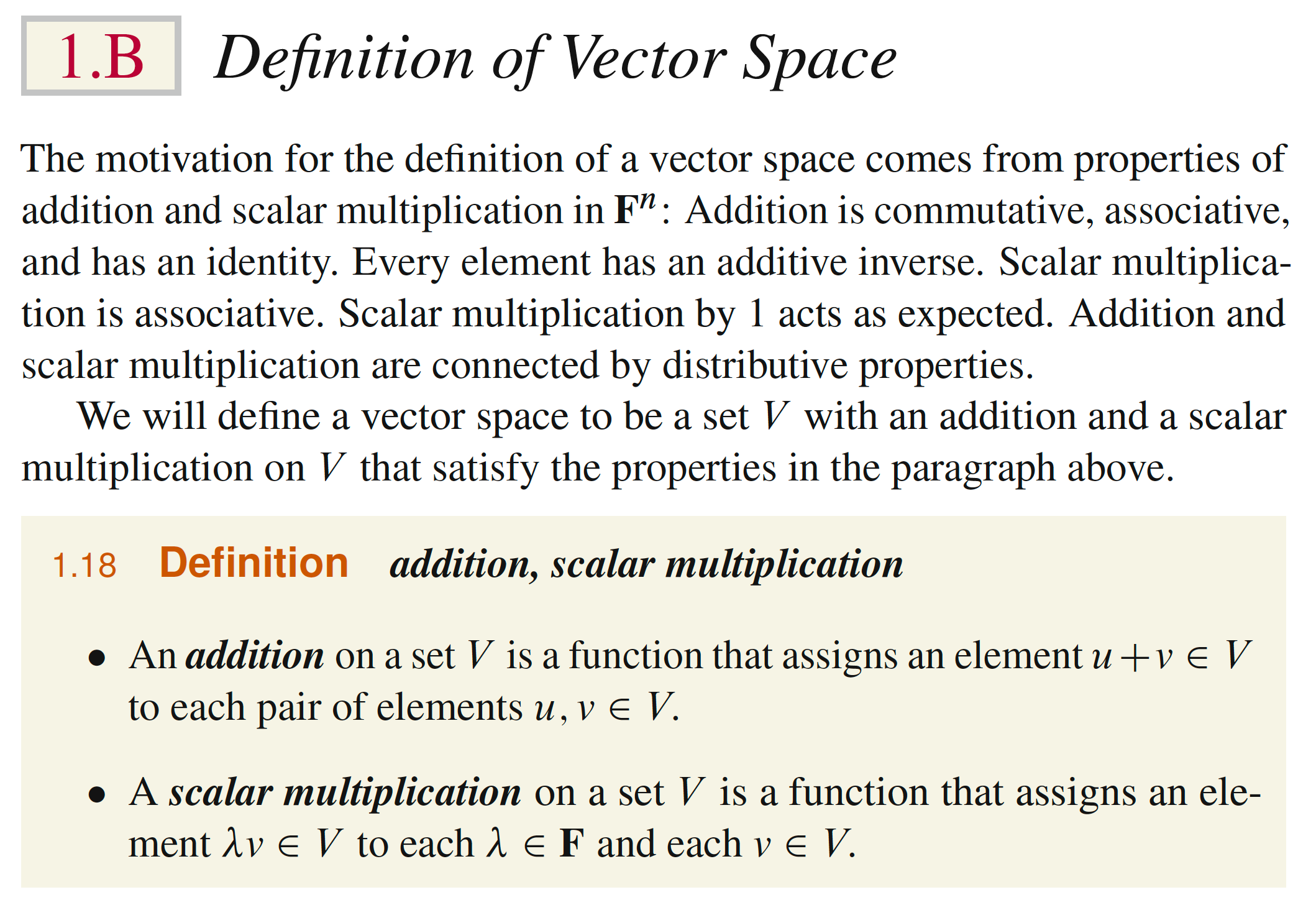
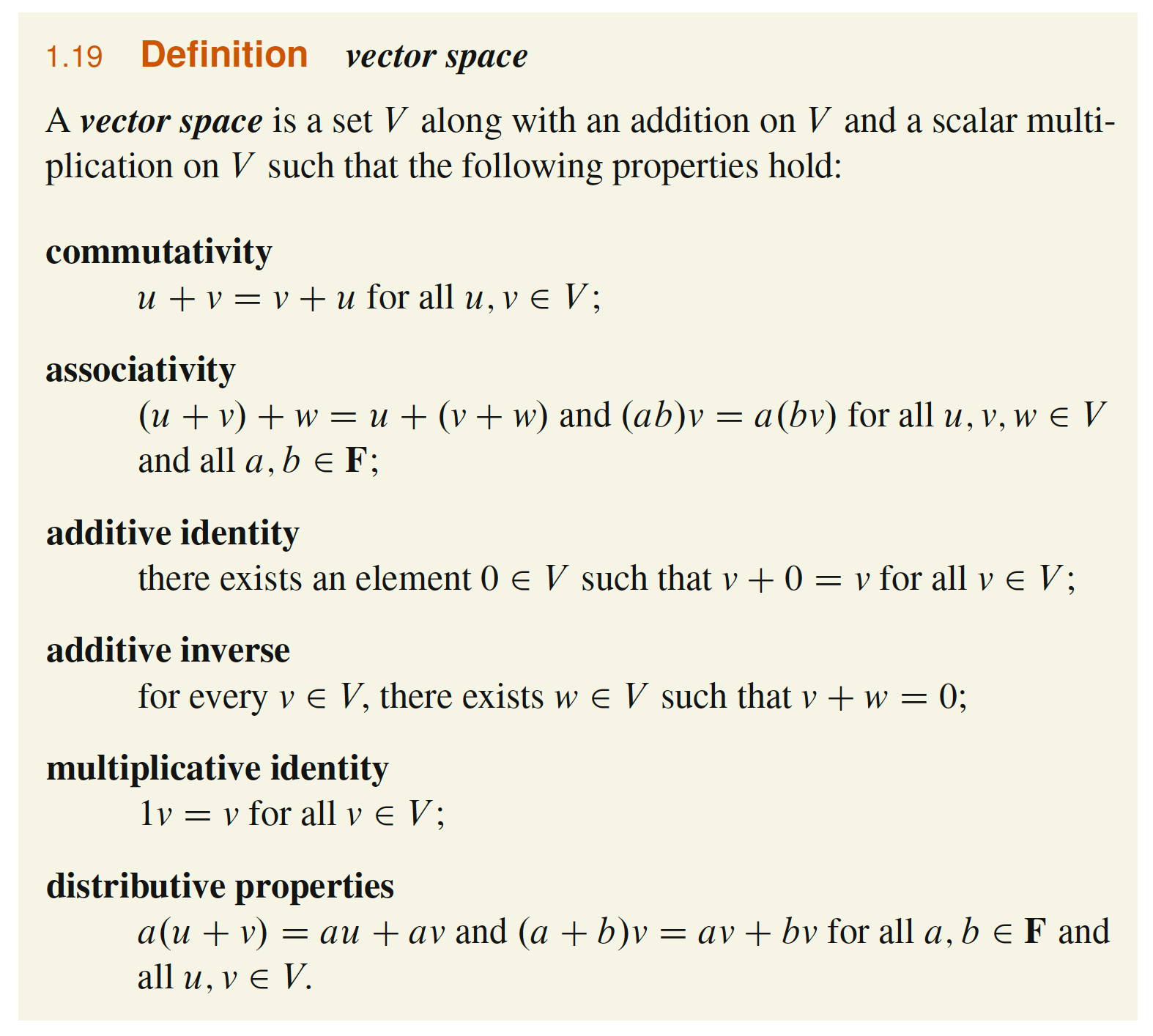
More formally, from Axler (2024) Section 1.2, but screenshot from an older edition of the book: (note: you can substitute out \(\mathbb{F}\) (field) for \(\mathbb{R}\); Axler generalizes to both real and complex spaces. Complex spaces are important for Fourier bases, but not important for you to understand the definition below.)
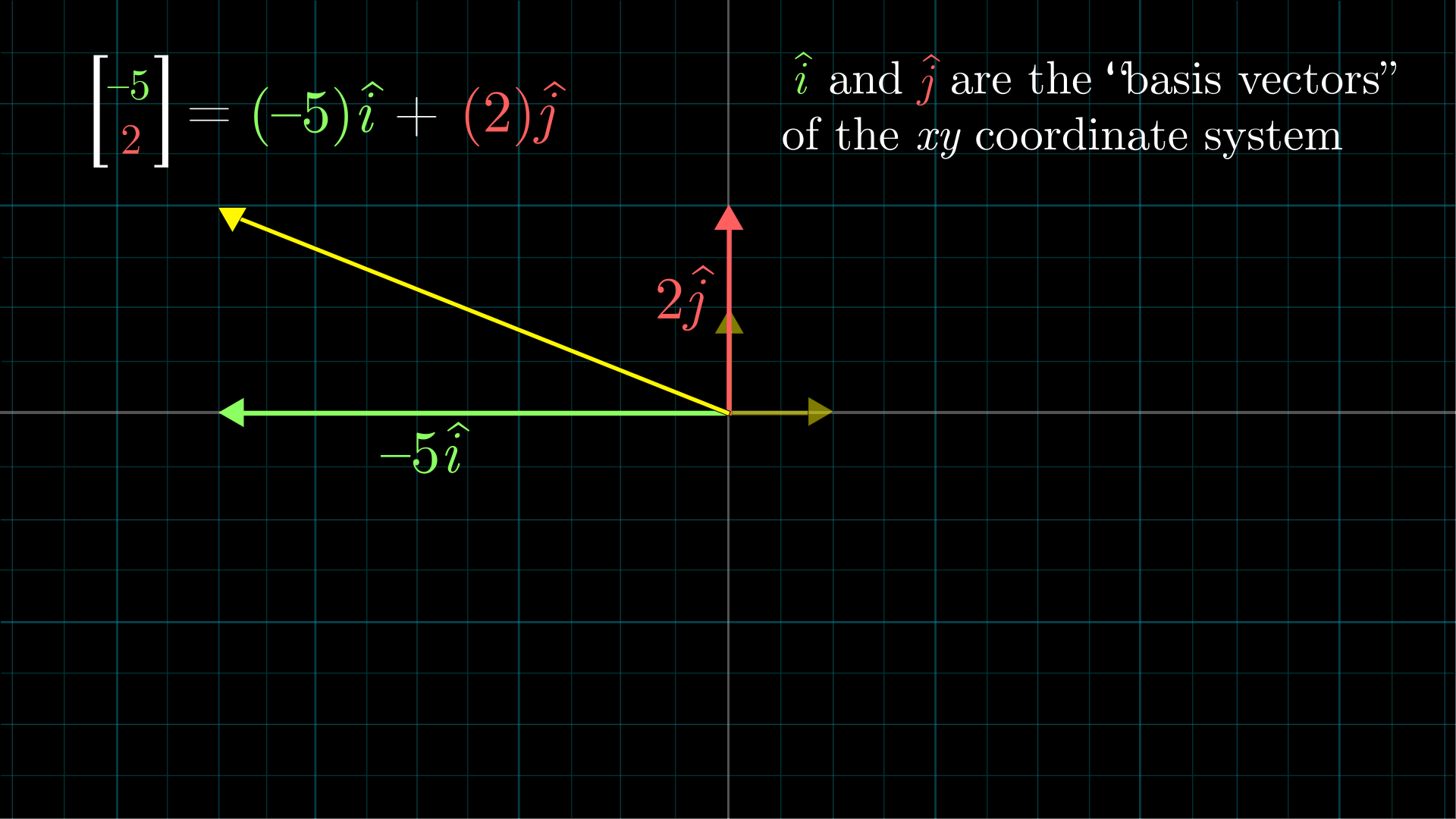
And once you have a vector space, you can introduce the idea of basis vectors.
A still of basis vectors from 3Blue1Brown's lesson on linear combinations, span, and basis vectors.
readings/who_is_fourier/: the inner product of two orthogonal vectors is 0. The same simple, geometric intuitions you have about vectors apply to "vector-ish" things like functions. These intuitions form the essence of approaches to scientific understanding of spaces that phonological concepts live in!
Here's a still from 3Blue1Brown's lesson on abstract vector spaces
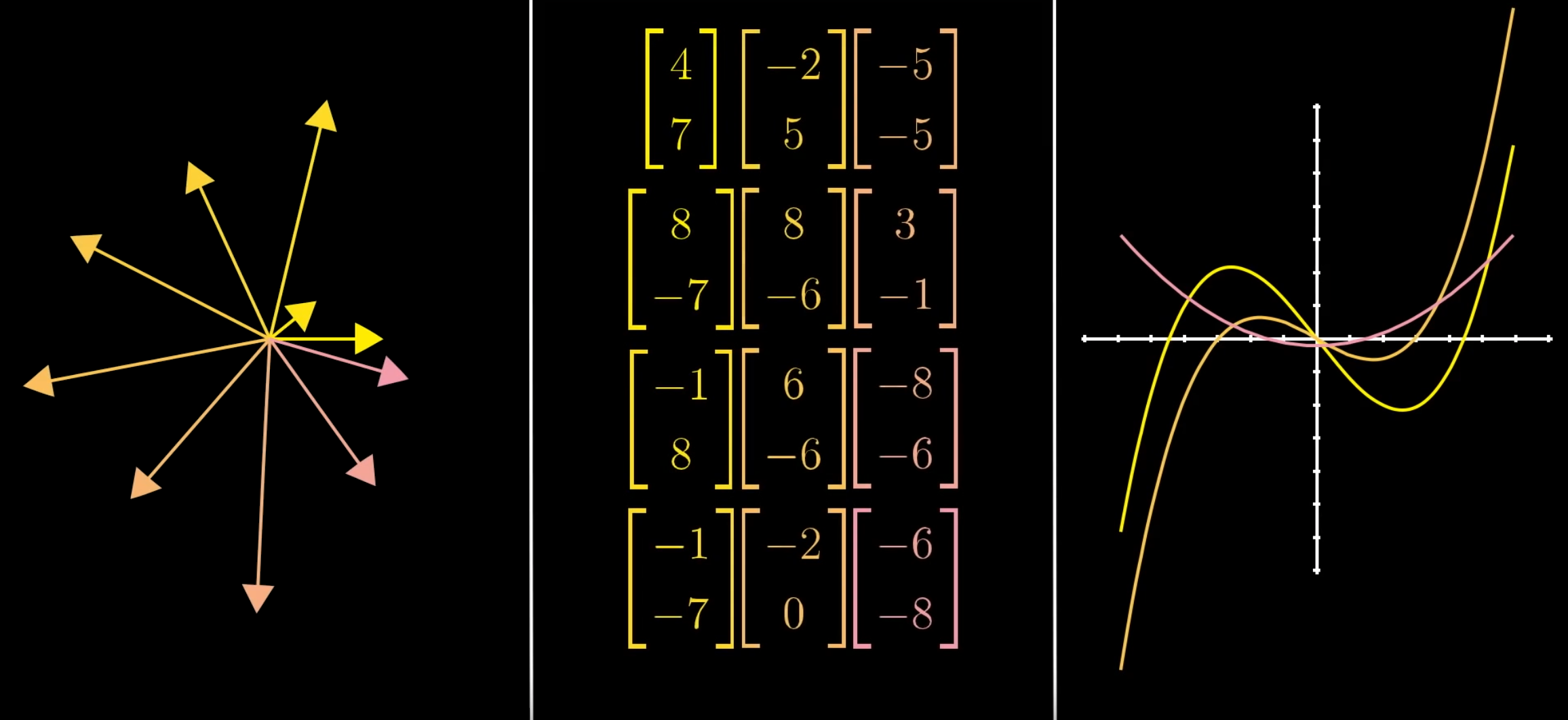
Let's watch a quick clip on how functions are like vectors from the abstract vector spaces video to remind ourselves what adding and scaling functions means...
Wait: but you've seen plenty of examples of basis functions in phonetics before!
A reminder of what sinusoids are via a unit circle animation from Lucas Vieira..

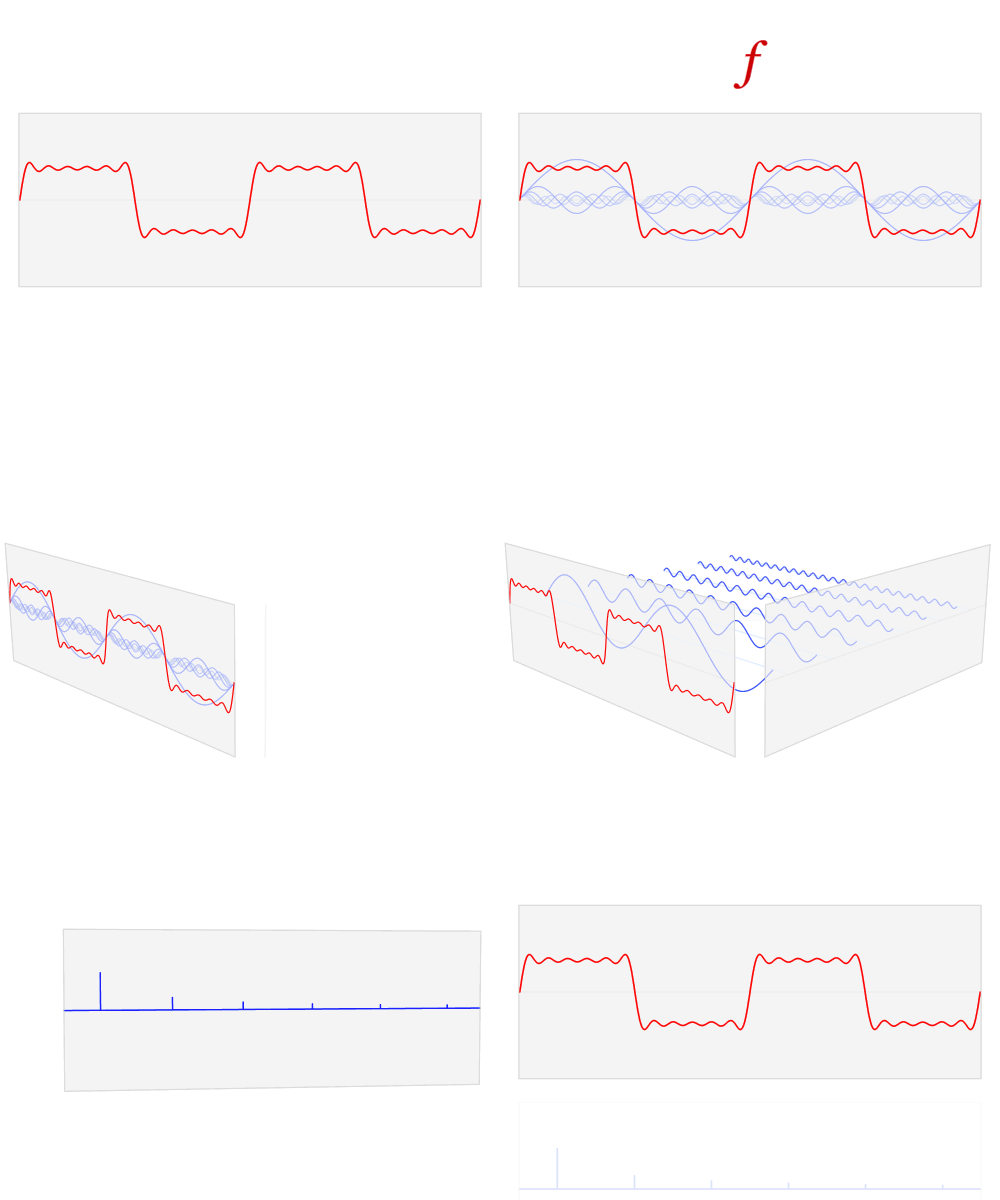
Let's also take a look at this interactive Fourier series demo
So what are basis functions? Think about basis vectors for the intuition!
What is orthogonality for functions? The inner product of two orthogonal functions is 0: see this animation of inner products for sinusoids from our same animator, Vieira (thank you Lucas!):

There are a number of orthogonal polynomials: I've seen Chebyshev and Legendre polynomials used before in prosody work.
Generalized Additive Models (GAMs): Animations from Gavin Simpson's GAMs webinar repo.
You give me a squiggly curve over [0,1]: some function \(f(x)\):
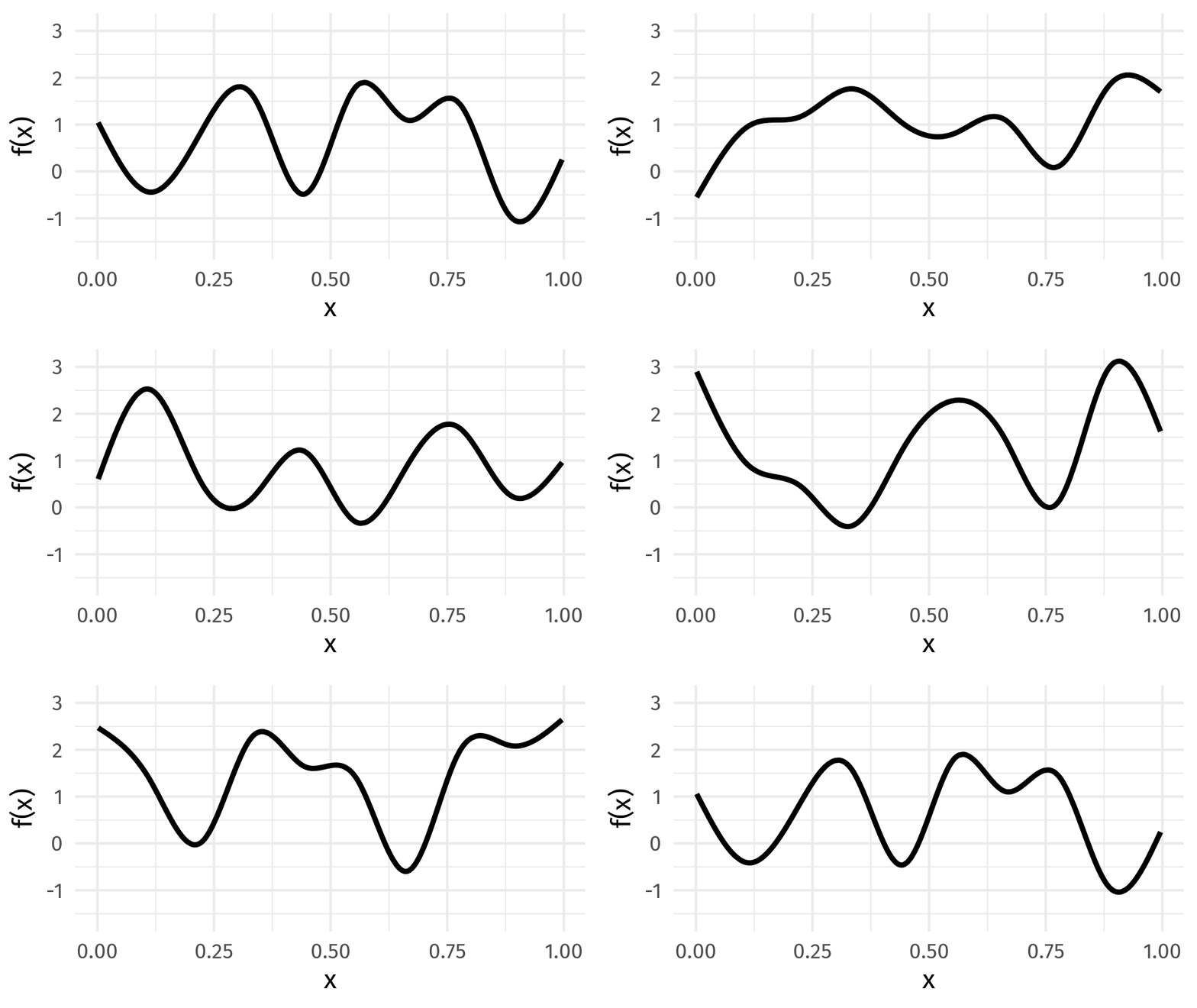
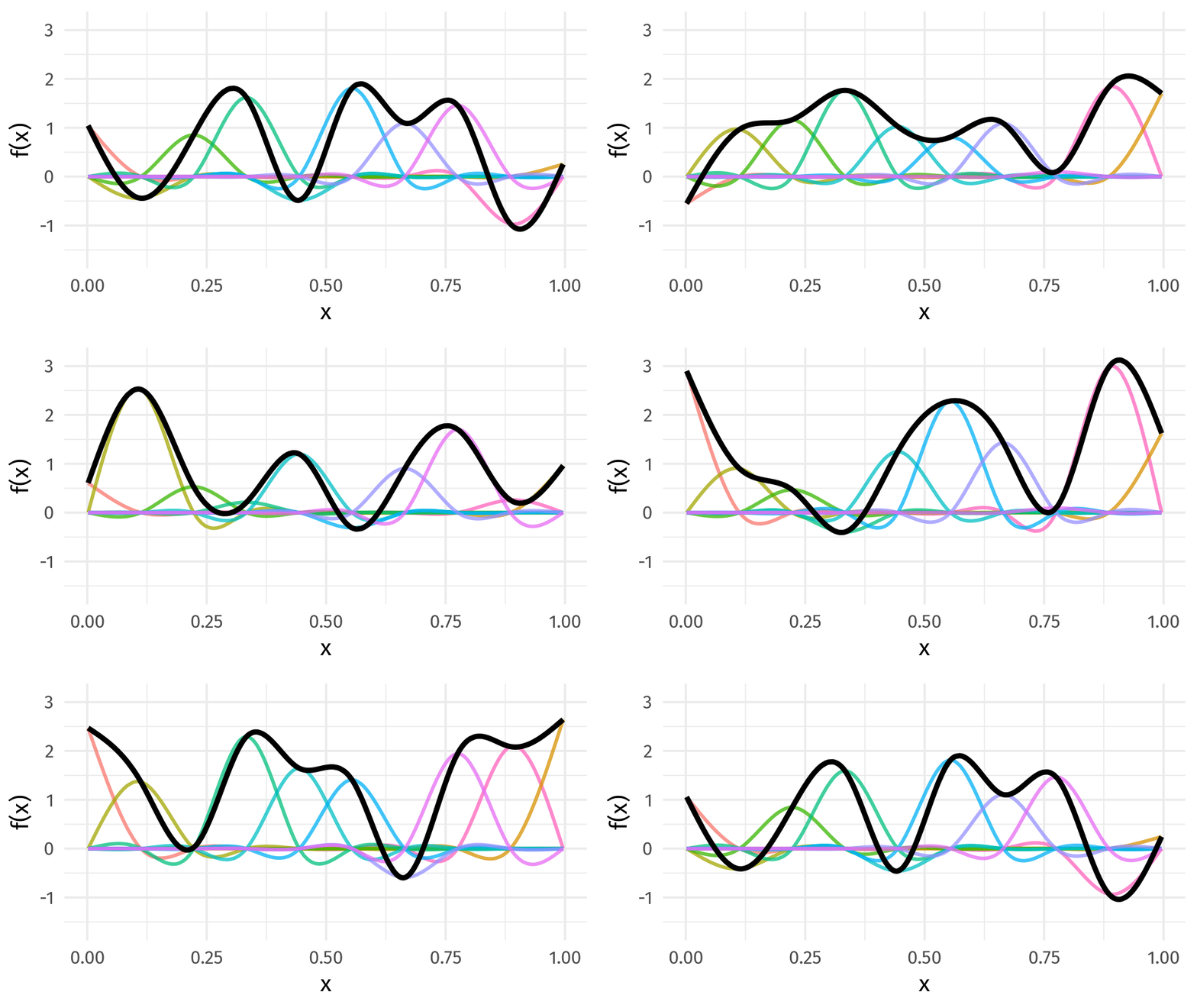
For some more intuition on splines, see Splines in 5 Minutes videos
For a more formal treatment of splines, see Ch. 7 of An Introduction to Statistical Learning
What is a dimension?
Flatland: A Romance of Many Dimensions
Key concepts leading up to dimension...(definitions adapted from Axler book, Ch. 2)
Linear combinations : A linear combination of a list \(v_1,\ldots, v_m\) of vectors in \(V\) is a vector of the form \[ a_1v_1 + \ldots + a_mv_m \] where \(v_1,\ldots, v_m \in \mathbb{R}\)
The set of all linear combinations of a list of vectors \(v_1,\ldots, v_m\) in \(V\) is called the span of \(v_1,\ldots, v_m\), and if the span of \(v_1,\ldots, v_m\) equals \(V\), we say that \(v_1,\ldots, v_m\) spans \(V\): it's a list that spans \(V\).
A list of vectors \(v_1,\ldots, v_m\) in \(V\) is called linearly independent if the only choice of \(a_1,\ldots, a_m\) in \(\mathbb{R}\) that makes \(a_1v_1,\ldots, a_mv_m\) in \(V\) equal to 0 is \(a_1 = \cdots = a_m = 0\). It's a linearly independent list.
A basis of \(V\) is a list of vectors in \(V\) that is linearly independent and spans \(V\).
The dimension of a finite-dimensional vector space is the length of any basis of the vector space (any two bases of a finite-dimensional vector space have the same length).

